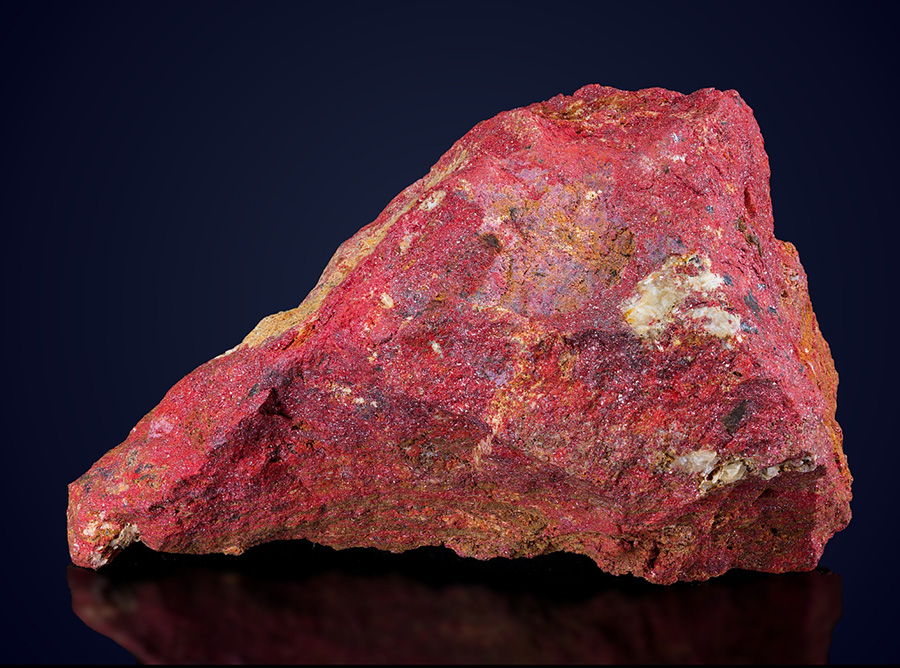
The Beginning: The story begins in 1845, when Andrés Castillero — a captain in the Mexican Army in the area on other business — visited Mission Santa Clara to see an old friend, Padre Real, who was the administrator of the mission. While there he noticed the vivid red pigment the Ohlone people used to paint the mission walls. The Ohlone had long known the hills of the park as a source of cinnabar, the brilliant red ore of mercury, which they ground for body paint and traded widely. Castillero suspected it might be an important ore, although he was not sure what it was at that point. The Ohlone had actually been mining cinnabar here for thousands of years and would show him a "Red Cave" or tunnel that extended roughly 50 to 60 feet into the side of what we now call Mine Hill. Castillero originally filed a claim for a silver and gold mine but later tested a sample and produced liquid mercury from it,[1] he quickly filed a new claim for a mercury mine with the Mexican government. His company began small-scale extraction at the "Santa Clara" mine in early 1846, before being sold to Barron, Forbes & Company later in the year. The firm, an English industrial and textile giant based in Tepic, Mexico, renamed the mine "New Almaden" (Nueva Almaden) after the Almaden[2] mine in Spain, which was the largest mercury mine in the world at the time. While Castillero would not return to the area, his name lives on to this day with the Castillero Trail and the nearby Castillero Middle School in San Jose.
The Perfect Timing:
The cinnabar ore being mined in New Almaden was so rich that by 1848 over 10,000 pounds of mercury a month were being produced using only a handfull of miners. Most of the underground work at that time was done by Yaqui Indians who carried about 200 pounds of ore up long wooden ladders in leather backpacks.
The excellent output of the New Almaden mine would soon be in high demand, following the discovery of gold in the Sierra Nevada foothills in early 1848. Mercury reacts with precious metals like gold to form an amalgam that allows miners to capture even the finest gold dust from crushed ore and river gravel. The heavy amalgam would be separated from the remaining dirt and gravel, then roasted to vaporize the mercury and leave the gold. Without a reliable local supply of mercury, processing California's gold would have remained slow, expensive, and dependent on imports, for example, from that original Almaden mine in Spain.
The cinnabar ore being mined in New Almaden was so rich that by 1848 over 10,000 pounds of mercury a month were being produced using only a handfull of miners. Most of the underground work at that time was done by Yaqui Indians who carried about 200 pounds of ore up long wooden ladders in leather backpacks.
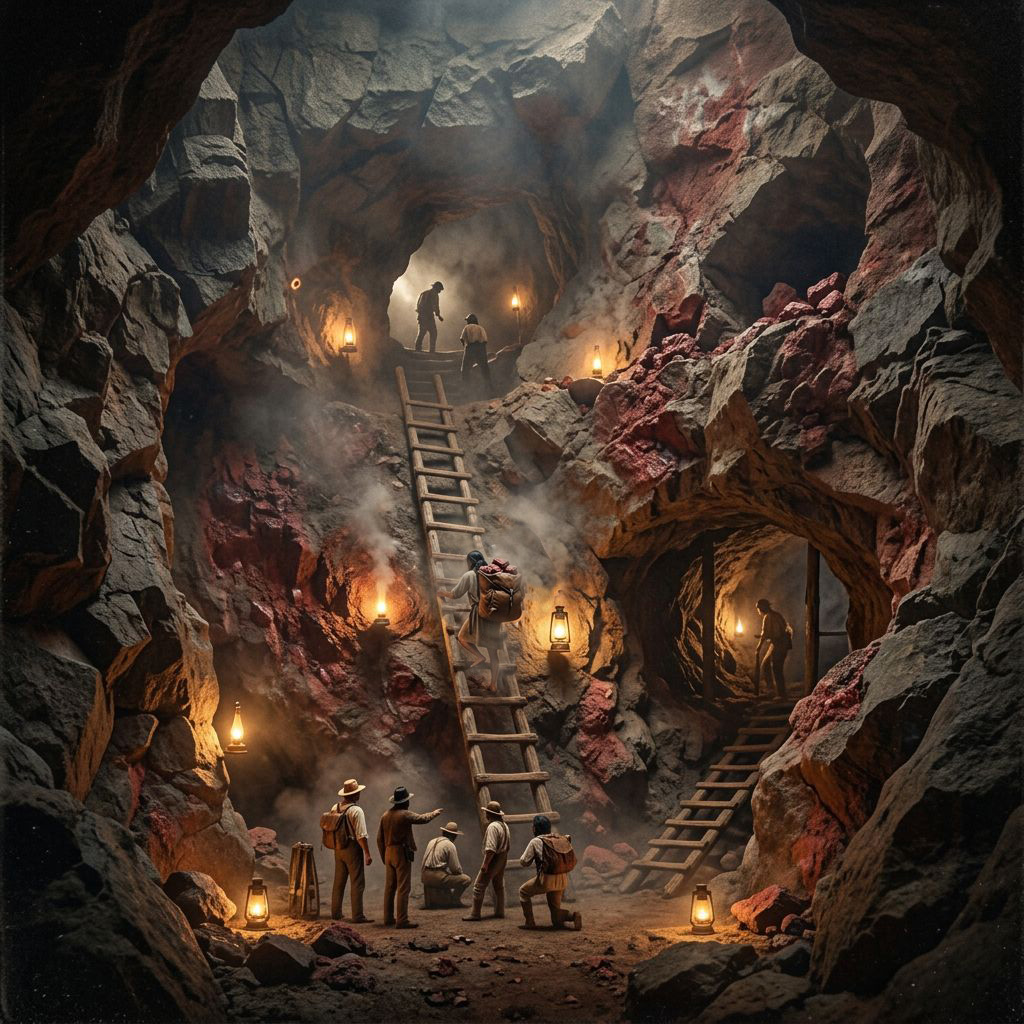
Yaqui Indians carry ore out of a stope in the upper levels of the New Almaden mine in 1854.[3] (Click for larger image)
Before New Almaden ramped up, a 76-pound flask of mercury cost around $100, with the price being fixed by the Rothschild banking family who controlled the Spanish Almaden mine. New Almaden broke the monopoly of "Old" Almaden and cut the price roughly in half, putting mercury within reach of the "49er" miners flooding into the Sierra Nevada foothills.
An Industrial Operation: The Barron, Forbes Company rapidly scaled up operations, bringing in workers from all over to dig shafts and tunnels deep into Mine Hill. The ore was hauled to the surface and carted to furnace yards at the base of the hills, where thirteen brick furnaces roasted the cinnabar. The mercury vapor rose through condensing chambers and emerged as liquid metal, then was poured into iron flasks and shipped to the mining camps of the Sierra Nevada. By the time the California Gold Rush wound down at the end of the 1850's, the New Almaden mine was the most valuable property in California, producing more wealth than any single gold mine in the state.
2. The word "Almaden" comes from the Arabic words "al", meaning "the" and "ma‘din", meaning the place of minerals, where "ma" is a word for place and "din" for minerals.
3. Image based on Western Mining History drawing re-imagined by me with the help of Google AI.