In its heyday, the park was the site of one of the most productive mercury mines in North America, employing over 1,100 workers. It began as a small operation registered as the "Santa Clara" mine in late 1845, before being sold to Barron, Forbes & Company in 1846 who renamed it the "New Almaden" mine. As can be seen in Figure 1, the mine was producing about 5,000 76-lb flasks of mercury a year by 1848. Barron, Forbes & Company rapidly scaled up operations, bringing in workers from all over the world. New Almaden became the most valuable property in California, generating more wealth than any single gold mine in the state.
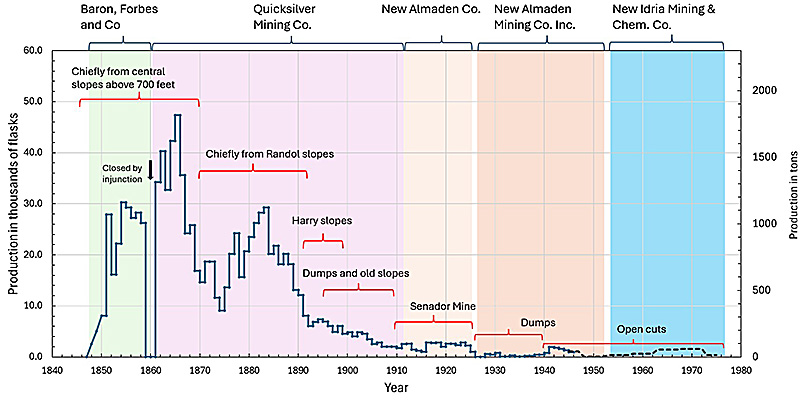
Figure 1. Production in the New Almaden mines showing the different owners and mining areas from 1845 to 1975.
(Click for larger image)
In 1864, the Quicksilver Mining Company of New York purchased New Almaden for $1.75 million and further modernized and expanded operations. Between 1864 and 1870, the output had risen to about 40,000 flasks a year, and New Almaden was able to supply the entire domestic demand for quicksilver in the United States while exporting heavily to China, Mexico, and South America. This product amounted to over $2.5 million worth of quicksilver annually — equivalent to more than $56 million today.
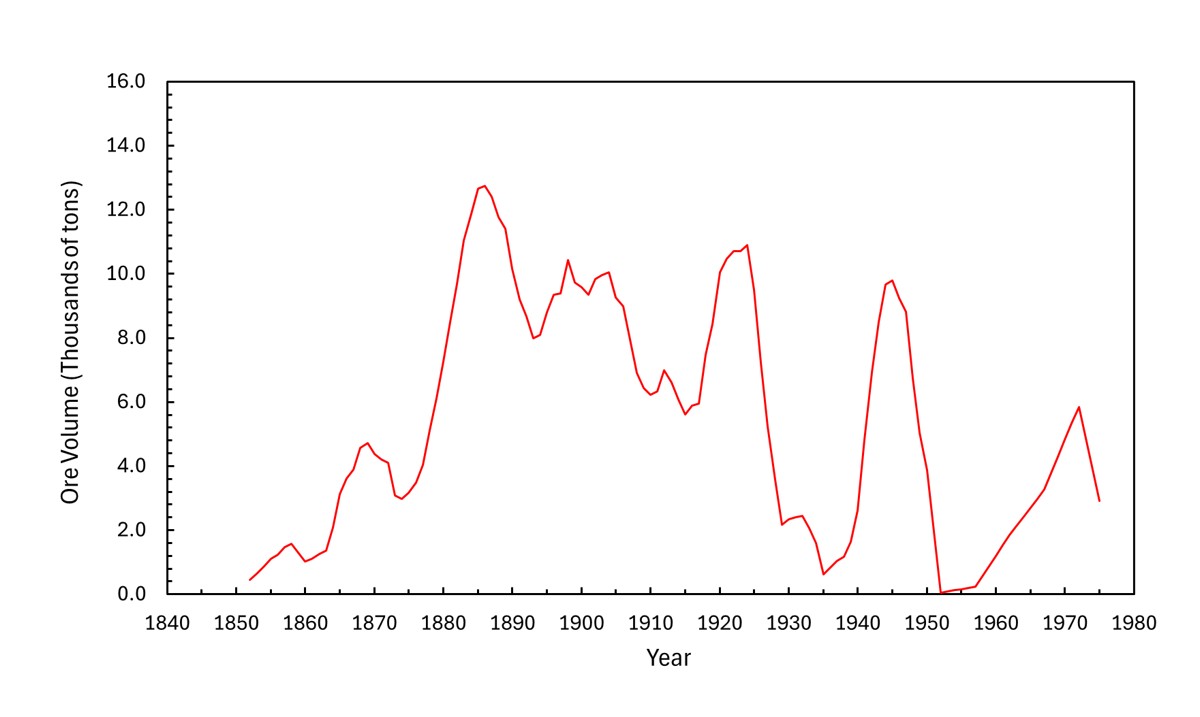
This success was in part due to the very high grade of the ore being mined from the slopes above 700 foot on Mine Hill, as shown in Figure 2. That ore was staggeringly rich, with over 20% mercury content. However, as you can also see in the two figures, around 1870 mining moved on to the Randol slopes as the rich veins of Mine Hill were depleted. The Randol yields were a lot lower and production fell back to 1850 levels. Then in the late 1870s, with the gold rush long over and other methods of gold extraction available, the price of mercury fell dramatically, further compromising the viability of the mine. Figure 3 shows the price of a flask of mercury over the lifetime of the New Almaden mines. The lower grade of ore meant that much more ore had to be processed, as shown in Figure 4. The economics were no longer working. By 1909, the mining camps of Spanishtown and Englishtown were largely ghost towns. In 1912, the Quicksilver Mining Company declared bankruptcy and closed the mine.
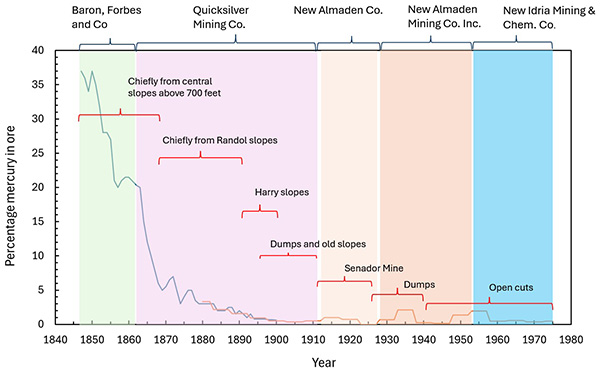
Figure 2. Ore grade in the New Almaden mines showing the different owners and mining areas from 1845 to 1975.
(Click for larger image)
Businessman George Sexton secured a lease on the property in 1915 and purchased the mining rights in 1917, and tried to revive the site. He formed the New Almaden Quicksilver Mines Corporation, which operated throughout the 1920s. Following Sexton’s death in 1927, that corporation also filed for bankruptcy. By then, the days of digging deep shafts were over because they were too expensive to drain and ventilate, but small-scale operators continued to try their luck. By this time the grade of the ore had fallen to a few percent or lower, up to 20 times lower yields than from Mine Hill in 1850.
In the quest for increased returns, a Gould rotary furnace was installed in 1939 to process ore more efficiently. This huge apparatus allowed massive amounts of lower-grade ore and 19th-century waste rock to be reprocessed for its trace amounts of mercury. Processing 100 tons at a time, the furnace could yield a ton of mercury (worth $6,800 in today's money) for every 1 percent mercury in the ore. A brief boom in demand during World War II revived activity for a few more years, but operations finally came to a permanent end in 1971, by which time mercury could no longer be mined profitably.
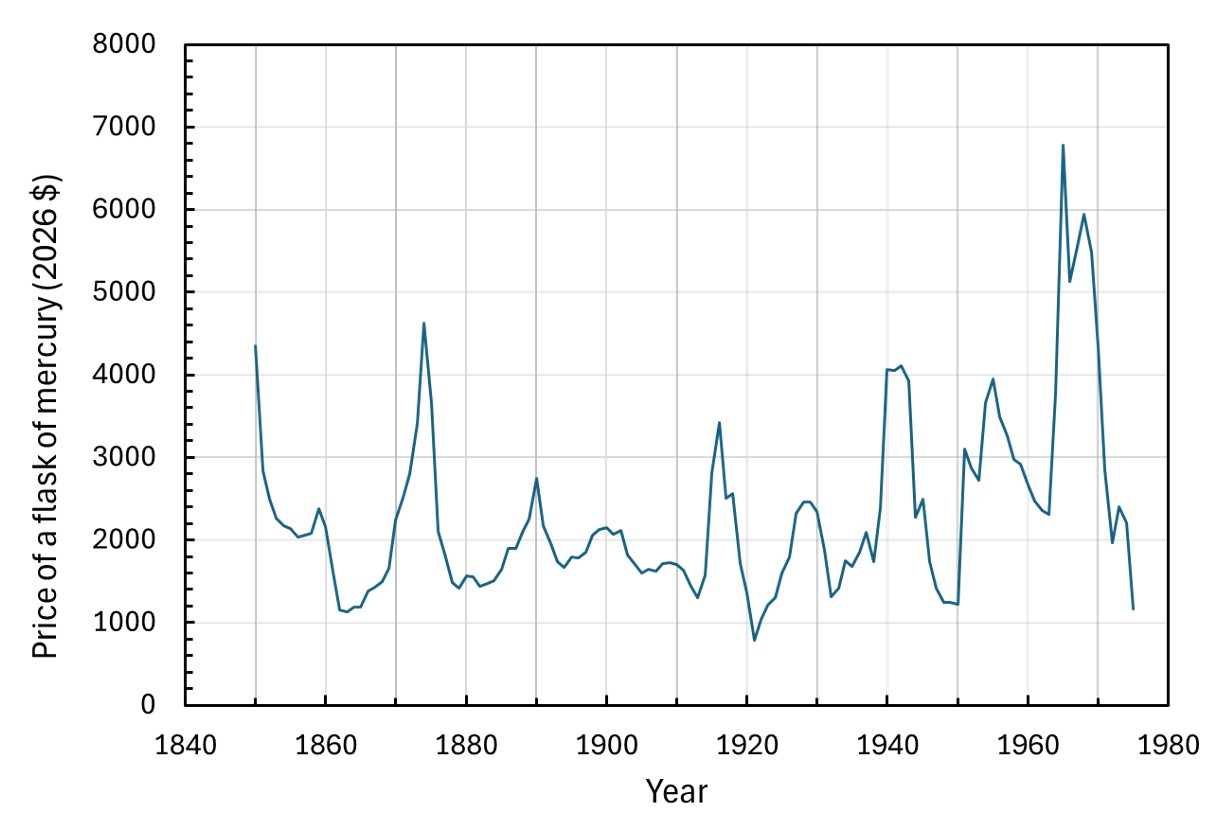
Figure 3. Price of a flask of mercury from 1850 to 1980 corrected for inflation to 2026 dollars.
(Click for larger image)